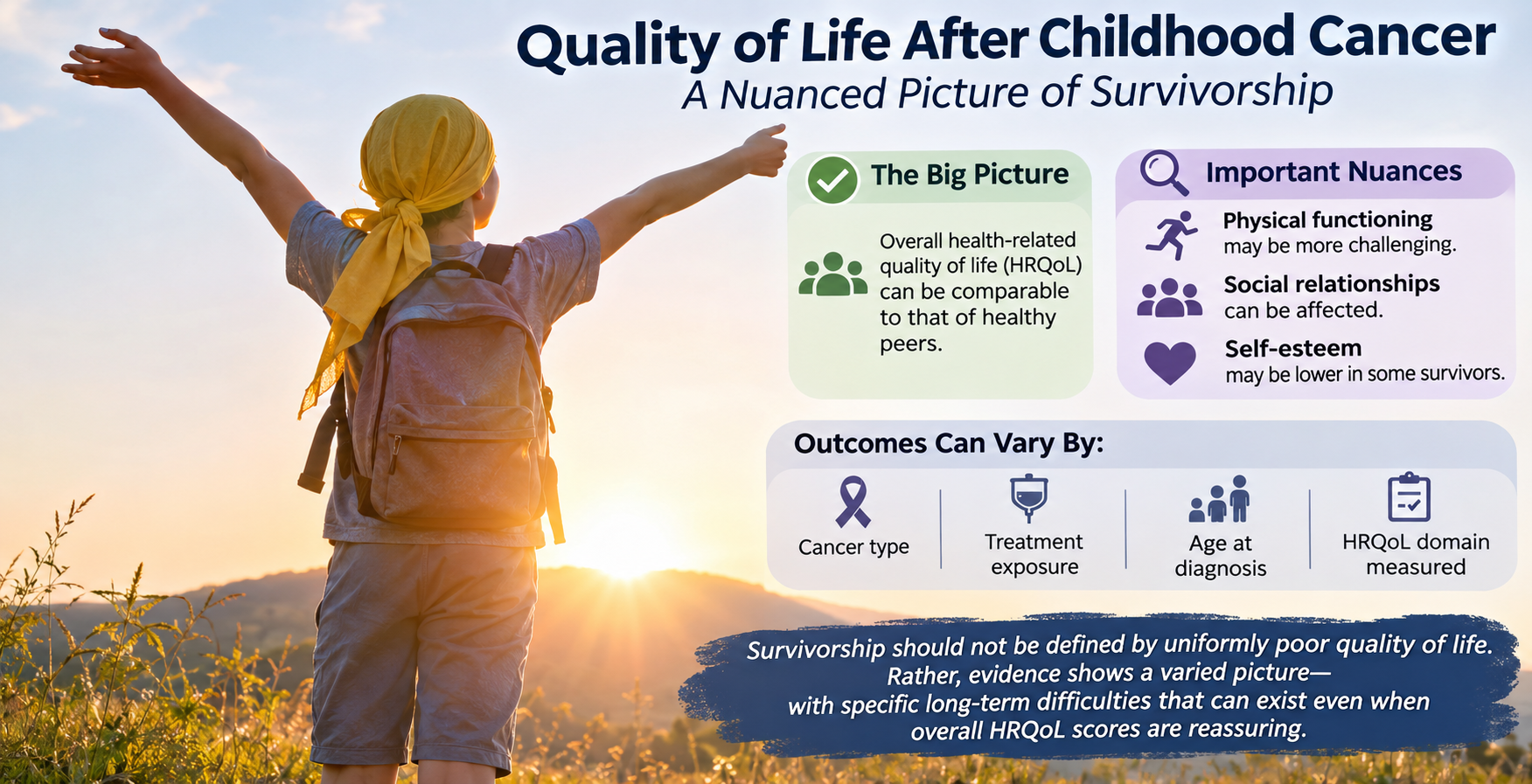


A systematic review of 41 studies documents fear of recurrence in survivors of childhood cancer and in their parents. Cohort studies add that survivors also fear second cancers and late effects, and that health-related quality of life can stay lower in specific domains years after therapy ends.
Key Takeaways
- Fear of recurrence is common. Across 41 studies (7,127 survivors, 1,696 parents), reported fear of cancer recurrence ranged from 11.5% to 88.9% in survivors and from 54.0% to 91.4% in parents.[4]
- Survivors fear more than relapse. In a 2026 Canadian cohort, fear of a second cancer (25.0%) and fear of future health problems (24.6%) were each reported slightly more often than fear of recurrence (21.8%).[6]
- Overall scores can hide domain-level deficits. Several studies found lower physical and social functioning in survivors, including in a group whose overall health-related quality of life matched that of controls.[8][9]
- Parents carry part of the burden. Parental fear can persist for years, and parents of leukemia survivors in a French cohort scored below population norms on physical health and social relationships.[4][12]
Childhood cancer does not stay confined to the disease. During treatment and for years afterward, it shapes a child’s emotional well-being, social development, schooling, and family life. Survival rates have risen substantially, yet many young patients and their families face lasting psychological and social difficulties that call for structured support.[1][2][3] Many survivors keep thinking about relapse, second malignancies, and the late effects of therapy. So do many of their parents, well after the last course of treatment.
In a 2026 systematic review in Academia Oncology, Angelina Bruseker and colleagues brought together the published data on fear of cancer recurrence (FCR) in childhood cancer survivors and their parents. [4] Studies in Cancer, Psycho-Oncology, Archives de Pédiatrie, and other journals add data on related fears and on health-related quality of life (HRQoL). This article summarizes that evidence for clinicians who follow survivors.
Fear of recurrence after treatment ends
FCR is usually defined as fear, worry, or concern that cancer will return or progress.[5] In survivors of childhood cancer, the worry often goes further: a second malignant neoplasm, long-term complications of treatment, or other serious illness. These concerns can affect mood, relationships, daily activities, and how survivors engage with health services.
Bruseker and colleagues searched PubMed, Embase, PsycINFO, and Web of Science and identified 10,267 records. After screening, the authors included 41 studies, covering 7,127 survivors and 1,696 parents across a range of ages, diagnoses, and stages of survivorship. These studies defined and measured FCR in very different ways, so the authors reported prevalence ranges rather than a pooled estimate. In survivors, reported FCR ranged from 11.5% to 88.9%. In parents, it ranged from 54.0% to 91.4%. The ranges differed by age. Among survivors aged 10–24 years, prevalence ranged from 29.0% to 55.2%. Among survivors aged 25 years or older, it ranged from 66.0% to 88.3%. Severe FCR was much less common: 0% to 20.1% in survivors and 9.0% to 10.0% in parents. The distinction matters clinically. A degree of worry about relapse is not the same as persistent, clinically significant fear that interferes with daily functioning.
Parents also experience substantial fear
Fear does not stay with the patient. Parents may keep worrying even after remission is confirmed and treatment is complete. In the studies reviewed, new physical symptoms, follow-up visits, medical examinations, and news of recurrence in other children could trigger that worry. For some parents, the fear lasts for years. The review identified studies in which mothers’ fear did not lessen with time. In one included study of 516 parents, mothers reported greater fear of progression than fathers.
Qualitative studies show how parental anxiety shapes family life. Some parents watched closely for symptoms, sought extra medical reassurance, or struggled to judge whether a new symptom signaled a health problem. Some remained uncertain whether their child was fully cured. These data support survivorship care that attends to the psychological well-being needs of parents as well as those of the survivor.
Fear of secondary cancers and future health problems
Perri R. Tutelman and colleagues, writing in Cancer in February 2026, examined three separate fears in a Canadian cohort of long-term survivors: [6]
- fear of cancer recurrence (FCR)
- fear of secondary cancer (FSC)
- fear of future health problems (FHP)
The 284 survivors had a mean age of 22.3 years and had been off treatment for a mean of 12.4 years. Thirty-seven percent reported at least one of the three fears. Fear of secondary cancer was the most common (25.0%), followed by fear of future health problems (24.6%) and fear of recurrence (21.8%). For these survivors, the chance of a second malignancy or chronic late effects was at least as much of a concern as relapse of their original cancer.
Fears often occurred together. Of the survivors who reported at least one fear, 40% reported one, 27% reported two, and 33% reported all three. In multivariable analyses, higher anxiety and a greater number of reported health problems were associated with cancer-related fears, as were certain substance-use behaviors. These are associations, not evidence of cause: physical health, psychological functioning, and behavior clustered in survivors who reported these fears. The authors concluded that multimodal interventions addressing cancer-related fears may help support adaptive coping throughout survivorship.
When ordinary symptoms raise alarm
Sarah J. Cunningham and colleagues asked whether survivors read common bodily symptoms as signs of relapse. [7] They studied 111 survivors recruited through a pediatric cancer center in Canada (mean age 17.7 years; range 8–25) and measured symptom frequency, symptom-related worry, general anxiety, FCR, and hrQoL. Sixty-two percent worried that at least one physical symptom might mean their cancer had returned. Pain caused the most concern. Survivors also worried about symptoms not typically associated with recurrence, including hunger, dizziness, and feeling cold.
Worry about symptoms was more strongly associated with FCR than was symptom frequency. The association held after adjustment for treatment-related factors and general anxiety. Symptom frequency and symptom-related worry each independently explained variation in hrQoL. Having a symptom and interpreting it are different. One survivor with pain may give it little thought; another with similar pain may take it as a sign of relapse. Symptom evaluation is still needed, and it is more complete when the clinician also asks how the survivor interprets the symptom and whether that worry affects daily life.
Health-related quality of life: beyond survival
Survival is the central outcome in pediatric oncology, but it does not describe how survivors live. Health-related Quality of Life (HRQoL) measures how disease, treatment, and later health problems affect physical, psychological, and social functioning. The domains interact. Physical limitations can restrict school, work, and social life. Anxiety and depression affect relationships and daily functioning. Treatment-related complications may need ongoing medical care. For many survivors, these issues continue into adulthood.
In a study published in Archives de Pédiatrie in 2023, Arzu Eroglu and Volkan Hazar assessed hrQoL with the Pediatric Quality of Life Inventory (PedsQL) in survivors aged 8–18 years who were at least five years past treatment, and compared them with age- and sex-matched healthy controls. [8] The study included 174 children across the two groups and 168 parents. Mean hrQoL scores were significantly lower in survivors than in controls (p = 0.04). The gap was clearest in physical functioning (p = 0.02) and social functioning (p < 0.01). Survivors of solid tumors scored significantly lower than survivors of hematologic malignancies (p = 0.02). HRQoL did not significantly differ between parents of survivors and parents of controls.
The deficits were still measurable at least five years after treatment, mainly in physical activity and social participation. The study also shows why HRQoL should be read domain by domain. A survivor can do well psychologically and still be limited physically or socially, and a global score will not reveal it.
Overall scores can mask specific deficits
Outcomes vary between survivor groups. An article by Paula J. Belson and colleagues, published in the Journal of Pediatric Hematology/Oncology Nursing in 2022, compared 101 adolescent and young adult survivors of retinoblastoma with 97 healthy controls using the PROMIS-29 profile and additional psychosocial measures.[9]
Overall hrQoL in the retinoblastoma survivors was comparable to that of controls. The individual domains were not. Survivors had significantly lower physical functioning (p < 0.001), lower social support (p = 0.013), and lower self-esteem (p = 0.028). Visual acuity and self-esteem together accounted for 52% of the variance in physical health summary scores. Self-esteem by itself accounted for 38% of the variance in mental health summary scores.
Eighty-six percent of the survivors in the study had normal vision, so the results should not be generalized to patients with more substantial visual impairment. Within that limit, the study shows that an overall score in the normal range can occur alongside specific functional and psychosocial deficits.
Treatment history and quality of life
Joy Benadiba and colleagues, in a 2015 study published in the Journal of Pediatric Hematology/Oncology, evaluated 630 long-term survivors of childhood acute lymphoblastic leukemia in the French Leucémies de l’Enfant et de l’Adolescent (LEA) cohort. They compared survivors who had received central nervous system (CNS) irradiation with those treated with chemotherapy alone. [10]
Mean time since diagnosis was 11.8 years. CNS irradiation was associated with a higher risk of late physical effects (odds ratio, 3.3; 95% CI, 1.8–5.9), including growth failure, secondary tumors, cataracts, and overweight. Quality-of-life scores did not differ significantly by treatment, although children and adolescents who had received CNS irradiation tended to score lower.
Age at assessment changed the result. Compared with French population norms, adult survivors had impaired quality of life, mainly in mental health domains: the mental composite score was 45.2 versus 47.9 in the reference population (p < 0.001). Pediatric survivors were not impaired relative to norms and tended to score higher, especially in social and relational domains. In this cohort, physical late effects did not translate directly into lower quality-of-life scores, and results differed by the survivor’s age. Long-term follow-up therefore needs both measures: treatment-related morbidity and the survivor’s own report of well-being.
Psychological health and neurocognitive functioning
Published in Pediatric Clinics of North America in 2020, Gisela Michel and colleagues reviewed psychological outcomes, hrQoL, and neurocognitive functioning in childhood cancer survivors and their parents.[11] The review covers depression, anxiety, worry, and posttraumatic stress, and also positive outcomes such as benefit finding and posttraumatic growth. The authors stress that childhood cancer affects the whole family and that its consequences can go beyond active treatment.
Depending on the disease and its treatment, survivors may have neurocognitive problems that affect learning and everyday functioning. These problems carry over into scholastic achievement, employment, social participation, and independence. This review also discusses interventions for survivors and parents with psychological difficulties. Although many survivors and parents adapt well over the long term, the authors concluded that a significant number of survivors and parents may still benefit from additional interventions. They further conclude that efficacious interventions still need evaluation and incorporation into routine clinical care.
Quality of life among parents of leukemia survivors
In a 2020 study published in Pediatric Blood & Cancer, Camille Vercasson and colleagues measured quality of life in 487 parents of childhood leukemia survivors in the LEA cohort. The mean age of the parents was 42.9 years, and the mean time since the child’s diagnosis was 7.3 years. We compared scores with age- and sex-matched values from a French reference population.[12]
Parents scored significantly lower than the reference population on physical health and social relationships (both p < 0.001). Their psychological health scores were significantly higher. Financial circumstances were the only factor associated with all three dimensions assessed. This differs from the Eroglu and Hazar finding of no hrQoL difference between parents of survivors and parents of controls. The two studies used different instruments and populations, and their results are not directly comparable. Both, however, indicate that parents belong in any assessment of the long-term effects of childhood cancer.
Triggers, coping, and family life
The Bruseker review identified circumstances that could trigger or intensify FCR:
- physical symptoms, particularly those resembling the original cancer
- medical appointments and surveillance examinations
- conversations and media coverage about cancer
- hearing of recurrence in other survivors
- diagnosis anniversaries and other reminders
Coping varied. Some survivors checked their bodies repeatedly or sought reassurance from parents and clinicians. Others avoided thinking about recurrence, kept a positive outlook, let distressing thoughts pass, or used distraction. FCR also reached into relationships. Some survivors had difficulty forming intimate relationships or talking about their family concerns. Among parents, the review described mothers who reduced their working hours or did not return to their previous jobs after their child completed treatment. FCR is therefore not an isolated psychological symptom. Its effects also extend to family relationships, social functioning, employment, and health care use.
Relevance to survivorship care
Medical surveillance is essential for detecting late effects, recurrent disease, and second malignancies. It does not address the emotional, physical, and social effects of living with uncertainty about future health.
Bruseker and colleagues list several approaches to support: screening for anxiety and distress, referral to appropriate professionals, psychotherapy, group-based support, and electronic health interventions.[4] They also note that evidence and specific clinical guidelines for FCR interventions in childhood cancer survivors remain limited. Measurement is a further problem. The included studies used 22 different questionnaires to assess FCR, and only seven were validated. That variability makes it difficult to compare populations or establish the true prevalence and severity of FCR.
The hrQoL studies point the same way. Assessment should separate physical functioning, psychological health, social relationships, and neurocognitive functioning rather than rely on an overall score. A survivor with good overall quality of life may still have restrictions in physical activity, social participation, or self-esteem. A survivor with good physical function may still need psychological support for persistent anxiety.
For long-term follow-up programs, this means adding patient-reported outcome measures to routine medical assessment: screening for distress, evaluating physical symptoms and how they are interpreted, assessing functional limitations, and asking directly about fear of recurrence and second cancers. These steps can help clinicians identify the survivors and family members who need more support.
Looking beyond survival
The growing number of childhood cancer survivors is one of pediatric oncology’s clearest successes. Survival, however, is only one measure of long-term outcome. The studies reviewed here show that fear of recurrence sits within a wider set of concerns: second cancers, future health problems, and interpreting everyday symptoms. Many survivors report satisfactory overall quality of life. Others have lasting impairments in physical, social, psychological, or neurocognitive functioning.
Not every survivor or parent experiences persistent distress. The clinical task is to identify those who do and to provide the medical, psychological, and supportive care they need throughout life.
References
[1] American Psychological Association. Examining the psychological impact of childhood cancer. Updated October 3, 2023. Online Online. Last accessed on November 21, 2026
[2] Lee J. Psychosocial impact of childhood cancer and guidelines for intervention. J Clin Psychooncology. 2025;11:3-6. doi:10.63977/jcpo.25.004 Article
[3] Gentile M, Ronconi L, Romeo M, De Vincenzo C, Burattini E, Rutigliano C, Santoro N, Zucchetti G, Fagioli F, Testoni I. Psychological and Psychosocial Effects of Cancer on Young Patients and Survivors in Italy: A Mixed-Methods Study on the Challenges and Meaning-Making Factors. Diseases. 2025 Nov 10;13(11):367. doi: 10.3390/diseases13110367. PMID: 41294907; PMCID: PMC12650988.
[4] Bruseker A, van Meelen TS, Burchell GL, Tromp JM, Merks JHM, Bramer JAM. Fear of recurrence among childhood cancer survivors and their parents: a systematic review. Academia Oncology. 2026;3(3). doi:10.20935/AcadOnco8524.
[5] Luigjes-Huizer YL, Tauber NM, Humphris G, et al. What is the prevalence of fear of cancer recurrence in cancer survivors and patients? A systematic review and individual participant data meta-analysis. Psychooncology. 2022;31(6):879-892. doi:10.1002/pon.5921.
[6] Tutelman PR, Duong J, Forbes C, et al. Fear of recurrence, secondary cancers, and health problems in long-term survivors of childhood cancer: findings from a Canadian cohort. Cancer. 2026;132(4):e70281. doi:10.1002/cncr.70281.
[7] Cunningham SJ, Patton M, Schulte F, Richardson PA, Heathcote LC. Worry about somatic symptoms as a sign of cancer recurrence: prevalence and associations with fear of recurrence and quality of life in survivors of childhood cancer. Psychooncology. 2021;30(7):1077-1085. doi:10.1002/pon.5647.
[8] Eroglu A, Hazar V. Evaluation of health-related quality of life in childhood cancer survivors. Arch Pediatr. 2023;30(2):89-92. doi:10.1016/j.arcped.2022.11.004.
[9] Belson PJ, Eastwood JA, Brecht ML, Kim JW, Hays RD, Pike NA. Health-related quality of life in adolescent and young adult retinoblastoma survivors. J Pediatr Hematol Oncol Nurs. 2022;39(6):342-357. doi:10.1177/27527530221073766.
[10] Benadiba J, Michel G, Auquier P, et al. Health status and quality of life of long-term survivors of childhood acute leukemia: the impact of central nervous system irradiation. J Pediatr Hematol Oncol. 2015;37(2):109-116. doi:10.1097/MPH.0000000000000209.
[11] Michel G, Brinkman TM, Wakefield CE, Grootenhuis M. Psychological outcomes, health-related quality of life, and neurocognitive functioning in survivors of childhood cancer and their parents. Pediatr Clin North Am. 2020;67(6):1103-1134. doi:10.1016/j.pcl.2020.07.005.
[12] Vercasson C, Auquier P, Michel G, et al. Quality of life in parents of childhood leukemia survivors. A French Childhood Cancer Survivor Study for Leukemia study. Pediatr Blood Cancer. 2020;67(10):e28419. doi:10.1002/pbc.28419.
[13] Horan MR, Srivastava DK, Choi J, et al. Multilevel characteristics of cumulative symptom burden in young survivors of childhood cancer. JAMA Netw Open. 2024;7(5):e2410145. doi:10.1001/jamanetworkopen.2024.10145.
Featured image: © 2026 CH. Used with permission