

For patients with early-stage lung cancer who cannot undergo surgery, precision radiation therapy is the main curative-intent option. A large phase 3 trial now shows what that treatment can achieve on its own, and what adding immunotherapy does not.
Key Takeaways
- SBRT alone produced an estimated two-year overall survival of 82% in the phase 3 SWOG/NRG S1914 trial of 417 patients at 146 US institutions. [1]
- Adding atezolizumab (Tecentriq®; Genentech/Roche), a programmed death-ligand 1 (PD-L1) blocking antibody approved in the United States for several indications in lung and other cancers, did not improve survival (HR 1.04) and raised grade 3 or higher adverse events from 3% to 12%, including two fatal respiratory events. [1]
- Centralized review of every radiation plan showed that high-quality SBRT can be delivered consistently across community and academic centers.
- The trial’s authors conclude that SBRT monotherapy remains the standard of care for inoperable early-stage NSCLC. [1]
A population with few options
Stereotactic body radiation therapy (SBRT) alone produced an estimated two-year overall survival of 82% in patients with medically inoperable, early-stage non-small cell lung cancer (NSCLC) in the phase 3 SWOG/NRG Oncology S1914 trial, published in The Lancet on September 6, 2026. [1] The same trial found that adding the PD-L1 inhibitor atezolizumab did not improve survival and roughly quadrupled the rate of serious adverse events. [1] For a patient population that is older, often frail, and burdened by heart and lung disease, the result reframes what a non-surgical, curative-intent treatment can deliver when it is planned and delivered with precision.
Surgery remains the preferred treatment for early-stage NSCLC in patients fit enough to undergo it. Many patients, however, are not candidates because of severe chronic obstructive pulmonary disease, cardiovascular disease, advanced age, or other comorbidities. Before SBRT was widely adopted, the outlook for these patients was poor. Conventional management achieved primary tumor control in only 30% to 40% of patients, and three-year survival ranged from 20% to 35%. [2] SBRT changed that picture. The technique uses image guidance, motion management, and many converging beams to deliver a very high radiation dose to the tumor in a small number of treatments, while limiting dose to surrounding lung, heart, airway, and chest wall.
The trial that established SBRT
The benchmark for SBRT in this setting has long been the phase 2 RTOG 0236 trial. [2] Investigators treated 55 evaluable patients with peripheral T1–T2N0M0 tumors smaller than 5 cm, using 54 Gy delivered in three fractions of 18 Gy over one and a half to two weeks. [2] Only one patient experienced a primary tumor failure, giving an estimated three-year primary tumor control rate of 97.6% (95% CI, 84.3%–99.7%). [2] Three-year overall survival was 55.8% (95% CI, 41.6%–67.9%), and median overall survival was 48.1 months. [2] Protocol-specified grade 3 and grade 4 treatment-related adverse events occurred in 12.7% and 3.6% of patients, respectively, with no treatment-related deaths. [2]
Five-year follow-up of the same cohort confirmed durable tumor control and showed that late toxic effects remained manageable, although recurrence, particularly at distant sites, continued to limit long-term survival. [3] A 2017 evidence-based guideline from the American Society for Radiation Oncology (ASTRO) concluded that SBRT has an important role in early-stage NSCLC, especially for medically inoperable patients with few alternatives. [4]
 Immunotherapy + SBRT
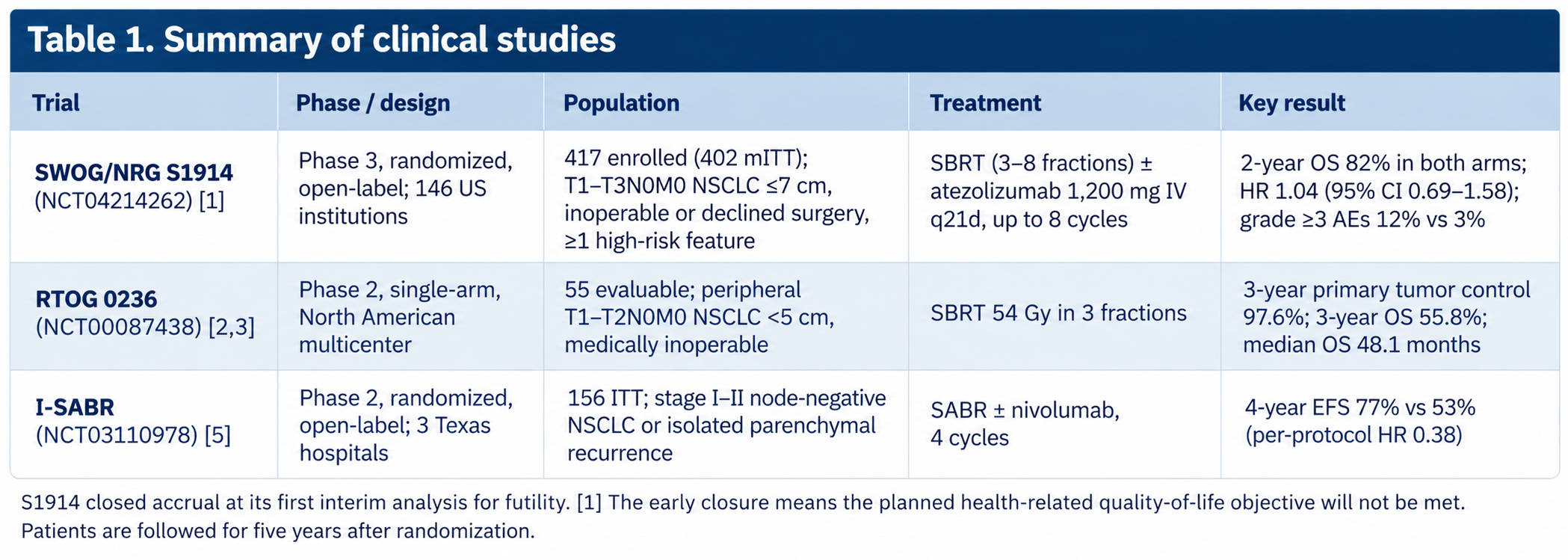
Because distant and regional relapse remain the dominant patterns of failure after SBRT, investigators have asked whether adding systemic immunotherapy could reduce recurrence. Immune checkpoint inhibitors already improve survival after chemoradiation in stage III disease, and preclinical work suggested that high-dose radiation may enhance anti-tumor immune responses. The S1914 trial (NCT04214262) was designed to answer that question in a randomized, phase III setting. [1] Patients with T1–T3N0M0 NSCLC measuring 7 cm or less were eligible if they were medically inoperable or declined surgery and had at least one risk factor suggestive of increased risk of recurrence. [1] Patients were randomly assigned to SBRT alone, delivered in three to eight fractions, or to SBRT plus atezolizumab 1,200 mg intravenously every 21 days for up to eight cycles. [1] In the combination arm, atezolizumab was given before, during, and after radiation, with SBRT starting at cycle three. [1] The primary endpoint was overall survival. [1]
Study findings
Between March 25, 2020, and September 9, 2024, the trial enrolled 417 patients at 146 institutions across the United States: 210 to the combination arm and 207 to SBRT alone. [1] The modified intention-to-treat population included 402 eligible patients, 201 per arm. [1] The median age was 72.8 years (IQR 67.4–78.4), and 54% of participants were female. [1] Accrual closed at the first interim analysis for futility. [1] In an updated analysis with a median follow-up of 24.8 months among living patients, the overall survival hazard ratio was 1.04 (95% CI, 0.69–1.58; one-sided p=0.58). [1] Estimated two-year overall survival was 82% in both arms (95% CI, 75%–87%). [1] Toxicity clearly favored radiation alone. Grade 3 or higher adverse events occurred in 12% of patients receiving atezolizumab plus SBRT, compared with 3% of those receiving SBRT alone. [1] Two grade 5 respiratory events were reported in the combination arm; none occurred with SBRT alone. [1]
 Charles B. Simone, II, MD, FASTRO, FACRO, FACR, Chief Medical Officer, New York Proton Center, Photo courtesy © 2026 New York Proton Center, Used with permission.
“An 82% two-year overall survival, achieved consistently across 146 institutions nationwide, is evidence that precise SBRT works at scale and for the patients who need it most,” said co-first author Charles B. Simone II, MD, Chief Medical Officer of the New York Proton Center.
Reading the 82% in context
With 417 patients enrolled, S1914 is the largest prospective SBRT trial reported in this population, and its two-year survival sets a new reference point. It was achieved in a population selected for higher recurrence risk, including tumors up to 7 cm, and in patients with a median age above 72. [1] Direct comparison with older studies requires care. RTOG 0236 reported survival at three years rather than two, enrolled smaller peripheral tumors only, and treated patients nearly two decades ago with a single-dose schedule. [2] S1914 also included patients who declined surgery, who may be healthier than those with strict medical contraindications. [1]
What can be said is that S1914 now provides the largest randomized, prospective dataset of contemporary SBRT outcomes in this population. Those outcomes were produced by community and academic centers alike under a common protocol.
Quality assurance at scale
SBRT is technically demanding. Small errors in target definition, patient positioning, or motion management can mean missing a tumor or overdosing a critical organ. In S1914, radiation treatment plans for patients at all 146 participating institutions underwent centralized quality assurance review. That approach shows that the precision achieved at high-volume academic centers can be reproduced across a national network when planning standards are defined and enforced.
A contrasting phase 2 signal
The S1914 result differs from the randomized phase 2 I-SABR trial, conducted at three hospitals in Texas. [5] In that study of 156 patients, adding four cycles of nivolumab (Opdivo®; Bristol Myers Squibb) to stereotactic ablative radiotherapy improved four-year event-free survival to 77%, compared with 53% with radiation alone (per-protocol HR 0.38; 95% CI, 0.19–0.75). [5]
The two trials differed in phase, size, number of centers, checkpoint inhibitor, treatment schedule, eligibility, and primary endpoint. I-SABR measured event-free survival; S1914 measured overall survival. [1][5] The I-SABR investigators themselves stated that their findings required confirmation in phase 3 trials. [5] S1914 is the first of those phase 3 cooperative group trials to be fully reported. [1] Its authors concluded that SBRT monotherapy remains the standard of care for this population. [1]
What this means for patients and physicians
For patients with early-stage NSCLC who cannot undergo surgery, or who choose not to, S1914 offers two practical messages. SBRT alone, delivered to modern quality standards, is associated with high two-year survival. Adding atezolizumab in this setting increased serious toxicity without improving survival. [1] The persistence of distant recurrence after SBRT means the search for effective systemic partners is not over. Any future strategy will now be measured against the 82% two-year survival established with radiation alone.
As the ASTRO guideline emphasizes, treatment decisions in this population should be made through shared decision-making, so that patients understand the benefits, risks, side effects, and alternatives available to them. [4]
Clinical trials
- Testing the Addition of the Drug Atezolizumab to the Usual Radiation Treatment for Patients With Early Non-small Cell Lung Cancer – ClinicalTrials.gov ID NCT04214262
- Stereotactic Body Radiation Therapy in Treating Patients With Inoperable Stage I or Stage II Non-Small Cell Lung Cancer – ClinicalTrials.gov ID NCT00087438
- Stereotactic Body Radiation Therapy With or Without Nivolumab in Treating Patients With Stage I-IIA or Recurrent Non-small Cell Lung Cancer – ClinicalTrials.gov ID NCT03110978
Highlights of Prescribing Information
SBRT is a radiation treatment technique, not a drug, and has no prescribing information. Atezolizumab, the agent tested in S1914, is not approved for use with SBRT in inoperable early-stage NSCLC; its use in that setting was investigational. [1]
Atezolizumab (Tecentriq®; Genentech/Roche) [Prescribing Information]
- Dosing in S1914: 1,200 mg intravenously every 21 days, for up to eight cycles. [1] Approved intravenous regimens also include 840 mg every 2 weeks and 1,680 mg every 4 weeks, depending on indication.
- Warnings and precautions: immune-mediated adverse reactions, which can be severe or fatal and can affect any organ, including pneumonitis, colitis, hepatitis, endocrinopathies, and nephritis; infusion-related reactions; complications of allogeneic hematopoietic stem cell transplantation; and embryo-fetal toxicity.
- Relevance to S1914: grade 3 or higher adverse events occurred in 12% of patients receiving atezolizumab plus SBRT, and both grade 5 events were respiratory. [1]
Nivolumab (Opdivo®; Bristol Myers Squibb)[Prescribing Information]
References
[1] Daly ME, Simone CB 2nd, Redman MW, Hsieh MH, Hesketh PJ, Hu C, Monjazeb AM, Steuer CE, Ganti AK, Kashani R, Bauman JR, Feliciano JL, Moon J, Ku K, Le-Lindqwister N, Baschnagel AM, Maraboyina S, Sherwood GB, Almquist D, Higgins KA, Gray JE, Bradley JD, Kelly K. Induction and consolidation atezolizumab with stereotactic body radiation therapy versus radiation alone in high-risk, early-stage non-small-cell lung cancer (SWOG/NRG S1914): a multicentre, open-label, superiority, phase 3, randomised controlled trial. Lancet. 2026 Sep 6:S0140-6736(26)01655-7. doi: 10.1016/S0140-6736(26)01655-7 Epub ahead of print. PMID: 42702214.
[2] Timmerman R, Paulus R, Galvin J, Michalski J, Straube W, Bradley J, Fakiris A, Bezjak A, Videtic G, Johnstone D, Fowler J, Gore E, Choy H. Stereotactic body radiation therapy for inoperable early stage lung cancer. JAMA. 2010 Mar 17;303(11):1070-6. doi: 10.1001/jama.2010.261. PMID: 20233825; PMCID: PMC2907644.
[3] Timmerman RD, Hu C, Michalski JM, Bradley JC, Galvin J, Johnstone DW, Choy H. Long-term Results of Stereotactic Body Radiation Therapy in Medically Inoperable Stage I Non-Small Cell Lung Cancer. JAMA Oncol. 2018 Sep 1;4(9):1287-1288. doi: 10.1001/jamaoncol.2018.1258. PMID: 29852036; PMCID: PMC6117101.
[4] Videtic GMM, Donington J, Giuliani M, Heinzerling J, Karas TZ, Kelsey CR, Lally BE, Latzka K, Lo SS, Moghanaki D, Movsas B, Rimner A, Roach M, Rodrigues G, Shirvani SM, Simone CB 2nd, Timmerman R, Daly ME. Stereotactic body radiation therapy for early-stage non-small cell lung cancer: Executive Summary of an ASTRO Evidence-Based Guideline. Pract Radiat Oncol. 2017 Sep-Oct;7(5):295-301. doi: 10.1016/j.prro.2017.04.014. PMID: 28596092.Epub 2017 Jun 5.
[5] Chang JY, Lin SH, Dong W, Liao Z, Gandhi SJ, Gay CM, Zhang J, Chun SG, Elamin YY, Fossella FV, Blumenschein G, Cascone T, Le X, Pozadzides JV, Tsao A, Verma V, Welsh JW, Chen AB, Altan M, Mehran RJ, Vaporciyan AA, Swisher SG, Balter PA, Fujimoto J, Wistuba II, Feng L, Lee JJ, Heymach JV. Stereotactic ablative radiotherapy with or without immunotherapy for early-stage or isolated lung parenchymal recurrent node-negative non-small-cell lung cancer: an open-label, randomised, phase 2 trial. Lancet. 2023 Sep 9;402(10405):871-881. doi: 10.1016/S0140-6736(23)01384-3. Epub 2023 Jul 18. Erratum in: Lancet. 2023 Sep 9;402(10405):850. doi: 10.1016/S0140-6736(23)01852-4. PMID: 37478883; PMCID: PMC10529504.
Featured image © 2026 Cha SBRT. Used with permission.
DOI