
The U.S. Food and Drug Administration (FDA) has approved pivekimab sunirine, an antibody-drug conjugate (ADC), for the treatment of adult patients with blastic plasmacytoid dendritic cell neoplasm (BPDCN), a rare and highly aggressive hematologic malignancy. Marketed under the brand name Decnupaz™ (AbbVie), this therapy represents the first and only ADC authorized for BPDCN, and the first that can be initiated in an outpatient setting.
Overview of BPDCN and Unmet Needs
BPDCN is characterized by overexpression of CD123 (interleukin-3 receptor-α) and affects an estimated 500 to 1,000 individuals annually in the United States, predominantly adult men aged 60 to 70 years. The malignancy often initially presents as skin lesions but can rapidly involve the bone marrow, lymph nodes, and central nervous system. Standard treatments—such as intensive chemotherapy, hematopoietic stem cell transplantation, or tagraxofusp (Elzonris®; Stemline Therapeutics, a Menarini Group Company)—often fail to yield durable remissions, with frequent relapses and poor long-term prognosis.
Mechanism of Action and Clinical Innovation
Pivekimab sunirine is a CD123-directed ADC comprising a high-affinity CD123 antibody, a cleavable linker, and an indolinobenzodiazepine pseudodimer cytotoxic payload. Upon binding to CD123-expressing BPDCN cells, the ADC is internalized and releases its payload, inducing single-strand DNA breaks and triggering apoptosis. This approval marks AbbVie’s first entry into the blood cancer ADC space, highlighting a broader commitment to targeted therapeutics for challenging malignancies. Ongoing research includes studies in both adult and pediatric populations with acute myeloid leukemia (AML), with clinical trials examining its use as monotherapy and in combination regimens (e.g., with fludarabine, cytarabine, G-CSF, and idarubicin).
Efficacy and Safety: Data from the CADENZA Trial
Regulatory approval was based on results from the Phase 1/2 CADENZA trial (NCT03386513), a multicenter, open-label, single-arm study involving adults with BPDCN. The trial enrolled 33 newly diagnosed and 51 relapsed or refractory patients, all without active central nervous system involvement. Efficacy was assessed by rates of complete remission (CR) or clinical complete remission (CRc):
- Newly Diagnosed Cohort: 69.7% achieved CR/CRc (median follow-up: 21.5 months); median duration of response was 9.7 months; 39.4% underwent post-study stem cell transplantation.
- Relapsed/Refractory Cohort: 15.7% achieved CR/CRc (median follow-up: 24.1 months); median duration of response was 9.2 months; 11.8% proceeded to transplantation.
The most frequently reported adverse reactions (≥20%) included edema, fatigue, musculoskeletal pain, bleeding, infusion-related reactions, nausea, and diarrhea. Pivekimab sunirine is accompanied by a boxed warning for hepatotoxicity, including the risk of hepatic veno-occlusive disease, as well as additional warnings for infusion reactions, edema, sulfite allergic responses, and embryo-fetal toxicity. Patients require regular laboratory monitoring for liver function, and premedication to mitigate infusion-related reactions is recommended.
Dosing and Administration
The recommended dosing of pivekimab sunirine is 0.045 mg/kg, administered intravenously over 15–30 minutes every three weeks based on actual body weight. Importantly, this ADC can be administered in the outpatient setting, improving accessibility and convenience for patients.
Regulatory Designations and Future Directions
Pivekimab sunirine received priority review, breakthrough therapy, and orphan drug designations from the FDA due to the critical unmet need in BPDCN and the therapy’s demonstrated clinical benefit. Its approval underscores ongoing progress in targeted oncology treatments and highlights AbbVie’s expanding pipeline, which features over 35 investigational therapies for hematologic and solid tumors.
Note: * The payload, FGN849, is a member of the indolinobenzodiazepine pseudodimer (IGN) class of cytotoxic drugs. It is an organic molecule described by its chemical structure: [(2S)-2-[[[4-(aminomethyl)phenyl]amino]methyl]-4-methyl-1,3-thiazol-5-yl]-(2-methylidenebenzoic acid).
Clinical trials
Study of IMGN632 in Patients With Untreated BPDCN and Relapsed/Refractory BPDCN – ClinicalTrials.gov ID NCT03386513
Combination Chemotherapy (FLAG-Ida) With Pivekimab Sunirine (PVEK) for the Treatment of Newly Diagnosed Adverse Risk Acute Myeloid Leukemia and Other High-Grade Myeloid Neoplasms – ClinicalTrials.gov ID NCT06034470
A Study to Assess Adverse Events and How Intravenous (IV) Pivekimab Sunirine Moves Through the Body in Pediatric Participants With Relapsed or Refractory Acute Myeloid Leukemia (AML) – ClinicalTrials.gov ID NCT07306832
Highlights of Prescribing Information
Pivekimab sunirine (Decnupaz™; AbbVie)[Prescribing Information]
Medication Guide
Pivekimab sunirine (Decnupaz™; AbbVie)[Medication Guide]
Reference
[1] Daver NG, Montesinos P, DeAngelo DJ, Wang ES, Papadantonakis N, Todisco E, Sweet KL, Pemmaraju N, Lane AA, Torres-Miñana L, Thompson JE, Konopleva MY, Sloss CM, Watkins K, Bedse G, Du Y, Malcolm KE, Zweidler-McKay PA, Kantarjian HM. Pivekimab sunirine (IMGN632), a novel CD123-targeting antibody-drug conjugate, in relapsed or refractory acute myeloid leukaemia: a phase 1/2 study. Lancet Oncol. 2024 Mar;25(3):388-399. doi: 10.1016/S1470-2045(23)00674-5. PMID: 38423051; PMCID: PMC11103591.
[2] Shimony S, Luskin MR, Gangat N, LeBoeuf NR, Feraco AM, Lane AA. Blastic Plasmacytoid Dendritic Cell Neoplasm (BPDCN): 2025 Update on Diagnosis, Pathophysiology, Risk Assessment, and Management. Am J Hematol. 2025 Aug;100(8):1408-1422. doi: 10.1002/ajh.27737. Epub 2025 Jun 17. PMID: 40525728. [Article]
[3] Pemmaraju N, Marconi G, Montesinos P, Lane AA, Mazzarella L, Sallman DA, Ulrickson ML, Schiller GJ, Erba HP, Wang ES, Walter RB, Deconinck E, Aribi A, Legrand O, Lebon D, Maisano V, Martinelli G, DeAngelo DJ, Derenzini E, Du Y, Lakshmikanthan S, Potluri J, Kantarjian HM, Daver NG. Pivekimab Sunirine in Blastic Plasmacytoid Dendritic Cell Neoplasm. J Clin Oncol. 2026 Apr;44(10):861-873. doi: 10.1200/JCO-25-02083. Epub 2026 Feb 11. PMID: 41671533; PMCID: PMC13011954. [Article]
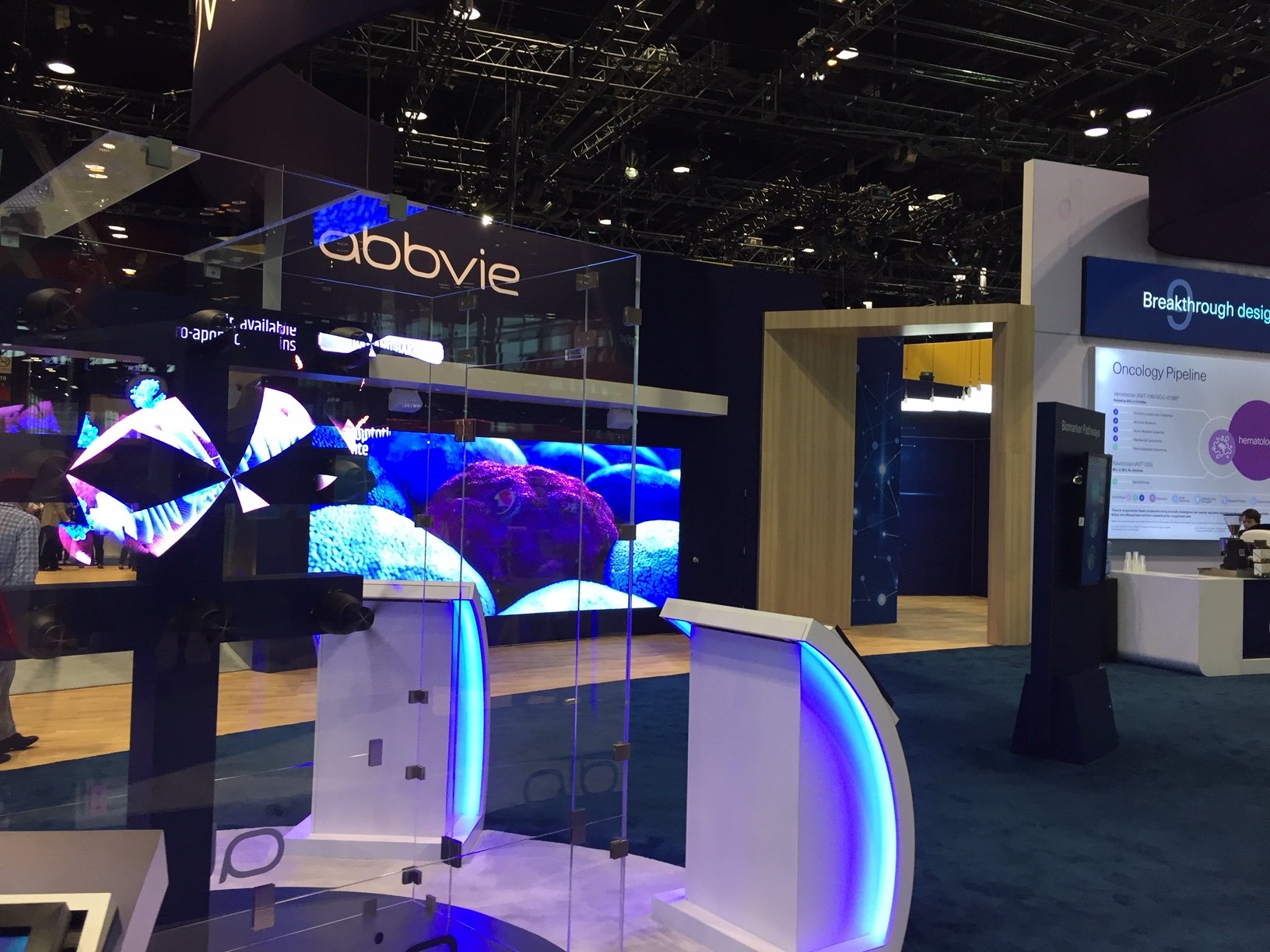
Featured image: AbbVie Booth – ASH 2018. Photo courtesy © 2018 – 2026 Sunvalley Communication.
DOI