Nested Therapeutics has reported initial results from a Phase 1 clinical study of NST-628, a brain-penetrant, non-degrading pan-RAF/MEK molecular glue, in patients with advanced solid tumors harboring RAS/MAPK pathway alterations.
The data, presented at the American Association for Cancer Research (AACR) Annual Meeting, held April 17 – 22, 2026, in San Diego, CA, demonstrate encouraging single-agent anti-tumor activity and a favorable tolerability profile, particularly in heavily pretreated NRAS and BRAF Class II/III melanoma, a patient subgroup with significant unmet clinical need and no approved targeted therapies following progression on immune checkpoint inhibitors.
 Oncogenic activation of the RAS/RAF/MEK/ERK pathway is a well-established driver of tumorigenesis across multiple solid tumor types. While selective inhibitors targeting specific RAS mutations (e.g., KRAS G12C) have shown clinical efficacy, most RAS and RAF mutations remain unaddressed by currently approved therapies.
NST-628 is a first-in-class, non-degrading molecular glue designed to inhibit RAF and MEK by stabilizing RAF-MEK complexes in an inactive conformation, thereby preventing downstream MEK and ERK signaling. Notably, NST-628 exhibits full brain penetrance, a feature critical for treating central nervous system (CNS) metastases.
Study
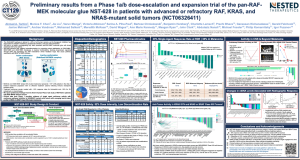
The ongoing Phase 1 study (NCT06326411), sponsored by Nested Therapeutics, is a two-part, open-label, single-arm study of single-agent NST-628 in adults with advanced solid tumors harboring RAS-MAPK pathway mutations who have exhausted standard treatment options. Part A (dose escalation) enrolled 64 patients across seven dose levels, followed by Part B (dose expansion) at the recommended dose for expansion (RDE). Efficacy assessments included objective response rate (ORR), disease control rate (DCR), and duration of response (DOR) per RECIST criteria. Safety and tolerability were evaluated according to CTCAE v5.0.
Initial Results
As of the data cutoff on February 1, 2026, 69 patients had received NST-628 (64 in escalation; 5 in expansion). At the RDE, among evaluable patients with NRAS or BRAF Class II/III melanoma (n=13), the ORR was 38%, and disease control was achieved in 85%. Across all tumor types (n=18), ORR and DCR were 33% and 72%, respectively. The median follow-up was 6.4 months, and the median DOR in melanoma had not yet been reached. Notably, responses were observed in diverse RAS/MAPK-driven tumors, including:
- KRAS-mutant ovarian and cervical cancers (ongoing partial response in a KRAS G12V-mutant cervical tumor exceeding 12 months)
- NRAS/BRAF-mutant colorectal cancer and BRAF Class II-mutant thymic cancer
- High-grade astrocytoma (BRAF V600E) with 70% tumor reduction, supporting CNS penetration
Reductions in circulating tumor DNA (ctDNA) correlated with radiographic response, further supporting the on-target mechanism.
 Safety
Based on the study outcome, researchers observed that NST-628 was generally well tolerated. The majority of treatment-related adverse events (TRAEs) were Grade 1 or 2 and consistent with the drug’s mechanism of action, including dermatologic, gastrointestinal, creatine kinase (CK) elevation, diarrhea, and ocular events. Grade ≥3 TRAEs were infrequent, with CK elevation being the most common. At the RDE, the discontinuation rate due to adverse events was 9%, and the median dose intensity was 82%. No Grade 5 events were reported.
These initial findings support the therapeutic potential of NST-628 in RAS/MAPK-driven malignancies, particularly in NRAS and BRAF Class II/III melanoma, where no approved targeted therapies are available after immune checkpoint inhibitor failure. The favorable safety profile, evidence of brain penetration, and clinical activity in both melanoma and non-melanoma RAS/MAPK-driven tumors are particularly significant. Preclinical data further suggest that NST-628 may synergize with KRAS G12D-selective or pan-RAS inhibitors, providing a rationale for future combination studies.
Ongoing development
NST-628 is a novel, brain-penetrant, non-degrading pan-RAF/MEK molecular glue demonstrating promising single-agent activity and acceptable safety in a heavily pretreated, molecularly defined patient population. Ongoing clinical development will further evaluate its role as monotherapy and in combination regimens, with the potential to address substantial unmet needs across RAS/MAPK-driven malignancies.
__
Clinical trials
A Study to Investigate the Safety and Efficacy of NST-628 Oral Tablets in Subjects With Solid Tumors (NST-628) – ClinicalTrials.gov ID NCT06326411
Reference
[1] Ahmad A. Tarhini, Monica Chen, Jia Liu, Varun Monga, Victoria Atkinson, Sarina A. Piha-Paul, Bartosz Chmielowski, Benjamin Herzberg, Charlotte Lemech, Prachi Bhave, Ganessan Kichenadasse, Gerald Falchook, Janice Mehnert, Andrae Vandross, Mohamad Salkeni, Meredith McKean, David Wages, Ann Marie Kennedy, Meagan B. Ryan, John Clark, Abdulaziz Nanah, Michael J. Fossler, Philip Komarnitsky, Igor Puzanov. Preliminary results from a Phase 1a/b dose-escalation and expansion trial of the pan-RAF-MEK molecular glue NST-628 in patients (pts) with advanced or refractory RAF, KRAS, and NRAS-mutant solid tumors [abstract]. In: Proceedings of the American Association for Cancer Research Annual Meeting 2026; Part 2 (Late-Breaking, Clinical Trial, and Invited Abstracts); 2026 Apr 17-22; San Diego, CA. Philadelphia (PA): AACR; Cancer Res 2026;86(8_Suppl):Abstract nr CT129.
Featured image: San Diego, CA – The AACR 2026 Annual Meeting – Photo courtesy © 2026 AACR/Scott Morgan. Used with permission.
DOI