

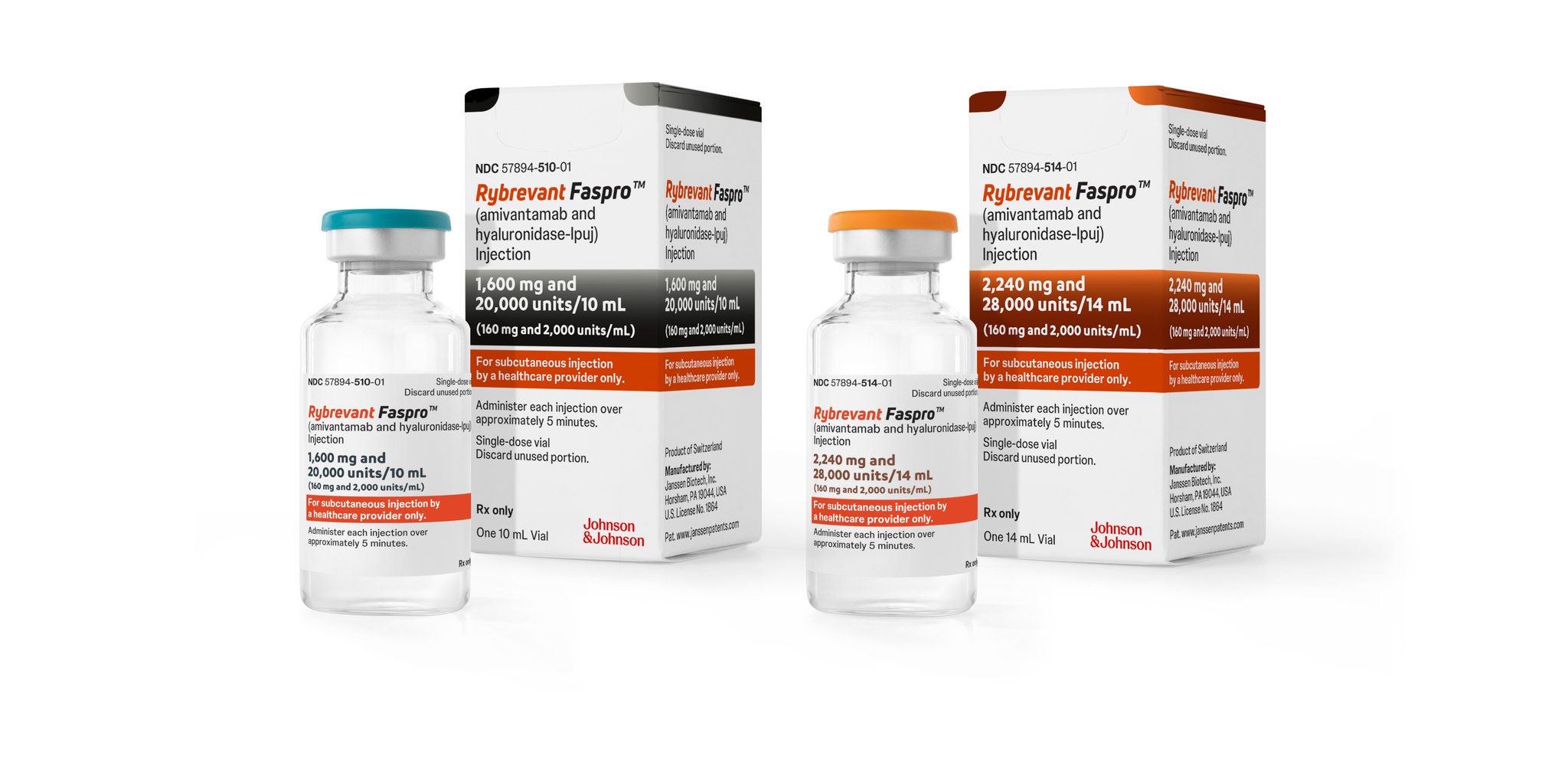

The U.S. Food and Drug Administration (FDA) has approved amivantamab and hyaluronidase (Rybrevant Faspro™; Johnson & Johnson), as the first and only subcutaneously (SC) administered therapy for patients with epidermal growth factor receptor (EGFR)-mutated non-small cell lung cancer (NSCLC).[1]
Amivantamab and hyaluronidase is approved across all indications of amivantamab (Rybrevant®; Johnson & Johnson), a first-in-class, fully-human bispecific antibody targeting EGFR and MET with immune cell-directing activity. Compared to intravenous (IV) delivery, Amivantamab and hyaluronidase offer significantly higher patient convenience and lower burden on healthcare resources [1][2][3][4][5]
- Reducing administration time from several hours to five minutes (significantly less administration time than chemotherapy-based regimens, which could take up to an hour);
- Demonstrating an approximately fivefold reduction in administration-related reactions (ARRs) (13% in SC vs 66% in the IV arm); and
- Reducing venous thromboembolism (VTE) incidence (11% in SC vs 18% in the IV arm).
Based on the results from the Phase 3 PALOMA-3 study (NCT05388669), amivantamab and hyaluronidase delivered consistent results to amivantamab, meeting both co-primary pharmacokinetic (PK) endpoints as measured by amivantamab levels in the blood [Ctrough on Cycle (C) 2 Day (D) 1 or C4D1 and C2 area under the curve (AUCD1-D15)]. [1][2][3][4][5][6]
Results from PALOMA-3 were first presented as a late-breaking oral presentation at the 2024 American Society of Clinical Oncology (ASCO) Annual Meeting and published in the Journal of Clinical Oncology.
Data presented at ASCO in 2024 and published in the Journal of Clinical Oncology also showed that the SC arm had a longer duration of response (DoR), improved progression-free survival (PFS), and longer overall survival (OS) than the IV arm. Median OS was notably higher in patients treated in the SC arm with lazertinib (Lazcluze®; Johnson & Johnson) (HR 0.62; 95% CI, 0.42–0.92; nominal P=0.02). At 12 months, 65 percent of patients receiving SC were alive, compared with 51 percent treated with IV. [6]
“Patients now have a simple, chemotherapy-free frontline option that not only targets the disease more precisely but also significantly improves survival,” said Joelle Fathi, D.N.P., Chief Healthcare Delivery Officer, GO2 for Lung Cancer.*
“With the introduction of amivantamab and hyaluronidase, care becomes faster, less invasive, and more aligned with what matters most to patients: time, comfort, and dignity. This therapy reduces the physical and emotional burden of lengthy infusions, giving
patients and their families the opportunity to reclaim precious moments and focus on living, rather than treatment.”
This milestone builds upon the statistically significant and clinically meaningful OS data demonstrated with amivantamab plus lazertinib for patients with untreated (first-line) locally advanced or metastatic NSCLC with EGFR exon 19 deletions (ex19del) or L858R substitution mutations in the Phase 3 MARIPOSA study.
At a median follow-up of 37.8 months, amivantamab plus lazertinib showed a statistically significant reduction in the risk of death compared with osimertinib (hazard ratio [HR], 0.75; 95% confidence interval [CI], 0.61-0.92; P=0.0048). Median OS had not yet been reached with the combination (95% CI, 42.9-not estimable), and the OS benefit is projected to exceed 4 years, which is at least 1 year beyond the median of 3 years observed with osimertinib (36.7 months; 95% CI, 33.4-41.0).[6]
“The combination of amivantamab plus lazertinib changes the biology of the disease by preventing resistance and delivers unmatched overall survival in the first-line setting, while omitting chemotherapy from treatment,” noted Danny Nguyen, M.D., Assistant Clinical Professor, Department of Medical Oncology & Therapeutics Research, City of Hope, and principal investigator for the PALOMA-3 and MARIPOSA studies.†
“Now, with the approval of amivantamab and hyaluronidase, we have an entirely new subcutaneous therapy that offers consistent results compared to intravenous delivery, while providing a more patient-centered experience.”
“The approval of amivantamab and hyaluronidase is a pivotal step forward, as EGFR+ NSCLC patients have previously faced limited treatment options,” explains Biljana Naumovic, President, Solid Tumor, Johnson & Johnson Innovative Medicine.
“Now, patients are gaining greater access to this transformative treatment, as well as the tools needed to proactively manage common dermatological effects.”
Lower ARRs (13% vs. 66%) were observed with amivantamab and hyaluronidase compared with IV administration. The incidence of ARRs that led to interruption of any study treatment was also substantially lower in the amivantamab, hyaluronidase, and lazertinib arm (1.0%). Among patients treated with amivantamab and hyaluronidase plus lazertinib with prophylactic anticoagulation (n=164), the VTE rate was 7%, indicating a return to baseline risk for patients with advanced NSCLC. Rates of VTE were lower (11% vs. 18%) in all patients treated with amivantamab and hyaluronidase plus lazertinib than in patients treated with IV administration.[1]
Overall, the safety profile of amivantamab and hyaluronidase was largely consistent with the known profile of IV administration when combined with lazertinib. The most common adverse reactions of amivantamab and hyaluronidase in combination with lazertinib (≥ 20 percent) were rash, nail toxicity, musculoskeletal pain, edema, fatigue, nausea, hemorrhage, peripheral neuropathy, decreased appetite, constipation, diarrhea, pruritus, and dry skin.[1]
__
Clinical trials
A Study of Lazertinib With Subcutaneous Amivantamab Compared With Intravenous Amivantamab in Participants With Epidermal Growth Factor Receptor (EGFR)-Mutated Advanced or Metastatic Non-small Cell Lung Cancer (PALOMA-3) – ClinicalTrials.gov ID NCT05388669
A Study of Amivantamab and Lazertinib Combination Therapy Versus Osimertinib in Locally Advanced or Metastatic Non-Small Cell Lung Cancer (MARIPOSA)
ClinicalTrials.gov ID NCT04487080
Highlights of Prescribing Information
Amivantamab and hyaluronidase (Rybrevant Faspro™; Johnson & Johnson)[Prescribing Information]
Amivantamab (Rybrevant®; Johnson & Johnson)[Prescribing Information]
Lazertinib (Lazcluze®; Johnson & Johnson)[Prescribing Information]
Reference
[1] George S, et al. Systematic literature review of intravenous versus subcutaneous administration of oncology therapies: A clinical, economic and patient perspective. Cancer Treatment Reviews. 2025 Sep; 139(102974):1-13.
[2] Bittner B, et al. Subcutaneous Administration of Biotherapeutics: An Overview of Current Challenges and Opportunities. BioDrugs. 2018 Oct;32(5):425-440.
[3] Aguiar-Ibáñez R, et al. Differences Between Intravenous and Subcutaneous Modes of Administration in Oncology from the Patient, Healthcare Provider, and Healthcare System Perspectives: A Systematic Review. Adv Ther. 2024 Dec;41(12):4396-4417.
[4] Epstein R S, et al. Cancer patients’ perspectives: A qualitative study of reasons for subcutaneous preference vs intravenous treatment. Abstract presented at: 2025 ASCO Annual Meeting; May 28, 2025; Chicago.
[5] Yang J, et al. Amivantamab Plus Lazertinib vs Osimertinib in First-line EGFR-mutant Advanced NSCLC – Final Overall Survival from MARIPOSA [ELCC abstract #40]. Presented at: 2025 European Lung Cancer Congress (ELCC); March 26-29, 2025; Paris, France.
[6] Leighl N, et al. Subcutaneous Versus Intravenous Amivantamab, Both in Combination With Lazertinib, in Refractory Epidermal Growth Factor Receptor–Mutated Non–Small Cell Lung Cancer: Primary Results From the Phase III PALOMA-3 Study. J Clin Oncol. 2024 Oct 20;42(30):3593-3605.
Featured image
DOI




 has approved amivantamab and hyaluronidase (Rybrevant Faspro™; Johnson & Johnson), as the first and only subcutaneously (SC) administered therapy for patients with epidermal growth factor receptor (EGFR)-mutated non-small cell lung cancer (NSCLC).[1])