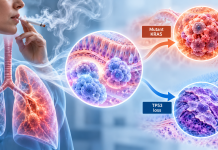
Scientists from the Florida campus of The Scripps Research Institute (TSRI), one of the world’s largest independent, not-for-profit organizations focusing on research in the biomedical sciences, have shown that a well-known cancer-causing gene, Notch 1, implicated in a number of malignancies plays a far more critical role in non-small cell lung cancer (NSCLC), the most common form of the disease, than previously thought.
The Notch signaling network is an intercellular signaling pathway which regulates interactions between physically adjacent cells. Notch 1 is a putative oncogene* in NSCLC and encodes the canonical member of the mammalian Notch receptor family. Activating lesions frequently affect Notch 1 in T-cell acute lymphoblastic leukemia (T-ALL) and, recently, have been found in non-small-cell lung cancer (NSCLC) as well. [1] In NSCLC activation of the pathway represents a negative prognostic factor.
This study helps us to understand, at a molecular level, the correlation between Notch 1 activity and poor prognosis in NSCLC patients carrying wild type p53.
These research findings establish the Notch 1 gene as a critical regulator of lung cancer tumor growth. This information could turn out to be vital for the design of potentially new therapeutic strategies for a group of patients who represent almost half of non-small cell lung cancer cases.
In the study, supported by the National Institutes of Health(NIH) and published the August 13, 2013 online edition of the journal Cancer Research, the scientists found that presence of known oncogene Notch 1 is required for survival of cancer cells. In both cell and animal model studies, disabling Notch 1 leads to a rise in cancer cell death.[2]
 Important target
?While Notch signaling has emerged as an important target in many types of cancer, current methodologies that target that pathway affect all members of the Notch family, and this has been associated with toxicity,? explained Joseph Kissil,Ph.D, (Photo) a TSRI associate professor who led the study. ?We were able to identify Notch 1 as the critical oncogene to target, at least in a common form of lung cancer.?
Tumor growth
The new findings show that Notch 1 is required for initial tumor growth, as it represses p53, a well-known tumor suppressor protein that has been called the genome?s guardian because of its role in preventing mutations. The p53 protein can repair damaged cells or force them to die through apoptosis? programmed cell death. Using animal models, the study shows that inhibition of Notch 1 signaling results in a dramatic decrease in initial tumor growth. Moreover, disruption of Notch 1 induces apoptosis by increasing p53 stability?substantially increasing its biological half-life, for example.
The study result implicate Notch 1 as a critical effector in K-ras-driven lung adenocarcinoma and as a regulator of p53 at a post-translational level. As a result, these findings directly provide important clinical insights into the correlation between Notch 1 activity and the poor prognosis of NSCLC patients who carry the non-mutated form of the p53 gene. ?If you look at lung cancer patient populations, Notch signaling alone isn?t a prognostic indicator, but if you look at p53-positive patients it is,? Kissil explained.
In an earlier and unrelated study, scientists found thatactivated Notch 1 substitutes for RAS activation synergistically with Myc in the development of NSCLC.[1]
* Putative oncogenes are those that have sequence analogies with known human oncogenes.
For more information:
[1] Allen TD, Rodriguez EM, Jones KD, Bishop JM. Activated Notch1 induces lung adenomas in mice and cooperates with Myc in the generation of lung adenocarcinoma.Cancer Res. 2011 Sep 15;71(18):6010-8. doi: 10.1158/0008-5472.CAN-11-0595. Epub 2011 Jul 29. [Article][PubMed]
[2] Licciulli S, Avila JL, Hanlon L, Troutman S, Cesaroni M, Kota S, Keith B, et al. Notch1 is required for Kras-induced lung adenocarcinoma and controls tumor cell survival via p53.Cancer Res. 2013 Aug 13. [Epub ahead of print][Article][PubMed]
Also read:
Hofland P. Notch1 Signaling Study Raises Safety Concerns About Experimental Cancer Approach. Onco’Zine, The International Cancer Network. January 25, 2011.[Article]
Photo: Joseph Kissi, Ph.D, Associate Professor at the Department of Cancer Biology, The Scripps Research Institute, Florida Campus. Photo Courtesy: The Scripps Research Institute (TSRI).
Copyright ? 2013 InPress Media Group/Sunvalley Communication. All rights reserved. Republication or redistribution of InPress Media Group/Sunvalley Communication content, including by framing or similar means, is expressly prohibited without the prior written consent of InPress Media Group/Sunvalley Communication. InPress Media Group/Sunvalley Communication shall not be liable for any errors or delays in the content, or for any actions taken in reliance thereon. Onco’Zine and Oncozine are registered trademarks and trademarks of Sunvalley Communication around the world.