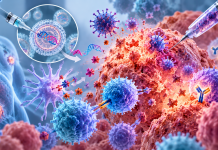
CAR-T therapy, which transformed the treatment of B-cell blood cancers, is now being tested as a way to reset the immune system in severe autoimmune disease. A new NEJM report offers some of the first data on what that could mean for women who want to become pregnant after treatment.
Key Takeaways
- From oncology to autoimmunity: CD19-directed CAR-T, first developed to eliminate malignant B cells, is being studied to remove the autoreactive B cells behind conditions such as lupus, myositis, and systemic sclerosis. Earlier case series reported sustained, drug-free remission, including in patients who had exhausted conventional therapies.
- Early pregnancy outcomes are encouraging: The NEJM report describes 13 patients across Germany, the United States, and Belgium who became pregnant after CAR-T for autoimmune disease. No disease relapses occurred, and eight healthy infants had been born at the time of the report. Some pregnancies were conceived within a few months of treatment.
- Looking beyond the birth itself: The investigators also assessed maternal and neonatal immune status. A healthy delivery alone cannot show how the therapy affects the mother and the developing child.
- A survivorship question for a new population: In oncology, the focus has expanded from whether CAR-T induces remission to how patients live afterward. The same question now applies in autoimmune disease, and for women of childbearing age it includes family planning. The cohort is small, so larger studies with longer follow-up are needed.
A transformation in progress
Some of the most important advances in medicine begin in oncology and eventually find applications in other fields of medicine. CAR-T therapy is emerging as a compelling example. Designed to selectively eradicate a population of cells of the immune system (B cells) which have become malignant, this technology has transformed treatment for hard-to-treat blood cancers. In recent years, researchers have asked whether this same targeted approach can be applied to autoimmune disease to reset the immune system.
As cancer treatment evolves, we have moved beyond asking solely whether a treatment can achieve remission to considering what that remission means for patients after treatment. The same is true as CAR-T moves into a new frontier. For women, who are disproportionately affected by autoimmune disease during their childbearing years, an important question is what CAR-T could mean for fertility and pregnancy.[1]
A recent report in the New England Journal of Medicine (NEJM) addressed this question, reporting on pregnancy outcomes in patients who received CAR-T therapy for autoimmune disease.[2] The publication, “Pregnancies in Patients with Autoimmune Disease Receiving CAR T-Cell Therapy,” documents pregnancy outcomes from 13 patients who received CAR-T therapy for autoimmune disease across centers in Germany, the United States, and Belgium. The early results are encouraging, with no disease relapses and eight healthy infants born at the time of the report. Some of these pregnancies were conceived within just a few months CAR-T therapy. And while the group was small, it offers some of the first insights into what pregnancy may look like after CAR-T for autoimmune disease.
How is CAR-T being used to treat autoimmune disease?
For those familiar with CAR-T therapy, the rationale for applying the science to autoimmune disease is compelling. CAR-T was developed to target CD19, a marker found on B cells, including the malignant B cells involved in certain blood cancers. Now, researchers are exploring whether that same approach can eliminate the autoreactive B cells that contribute to autoimmune disease and potentially reset the immune system.
A 2024 case series of patients with severe lupus, myositis and systemic sclerosis found sustained, drug-free remission following CD19 CAR-T treatment, including in patients who had exhausted conventional therapies.[3]
This approach is being studied at a small number of U.S. centers, including Atlantic Health, which, in partnership with its advanced Cellular Therapy Program, enrolled the first U.S. patient in a phase 1 trial of CAR-T for severe, refractory systemic lupus erythematosus (SLE) [4]. The trial is conducted through the Atlantic Health Clinical Research and Innovation Institute, which provides centralized operations and oversight for clinical research across the health system. That patient was initially reported in the journal Clinical and Experimental Rheumatology, and was among those whose pregnancy outcomes reported in the NEJM publication. [2,5]
What does CAR-T mean for pregnancy and fertility?
CAR-T has nearly a decade of experience in oncology [6], while its use in autoimmune disease is still in early stages. This means researchers are only beginning to scratch the surface in understanding whether CAR-T can induce remission in autoimmune disease, and what life may look like post-treatment.
That question is particularly relevant in lupus, in which the body’s immune system mistakenly attacks the body’s tissues and organs, as the disease can present additional challenges during pregnancy, including higher risks of complications for both mother and baby [7]. If CAR-T can ultimately provide sustained remission without the need for ongoing immunosuppression, it could offer a very different path for some patients considering pregnancy. While research is still underway, this underscores the value of studies like this in helping physicians and patients better understand the potential implications of CAR-T for family planning.
Delivering a healthy baby is a landmark, but not complete, measure of success. Understanding the full impact of CAR-T during pregnancy requires looking beyond the pregnancy outcome itself. This is why the study also examined maternal and neonatal immune status, providing additional insight into how the treatment may affect the mother and developing child- all questions that cannot be answered by birth alone.[5]
What comes next for CAR-T?
As experience with CAR-T therapy has grown in oncology, the field has begun to move beyond a singular focus on whether treatment can induce remission. As more patients achieve durable remission after treatment, researchers are increasingly asking what life looks like beyond disease control, including quality of life, psychological well-being, fatigue, and other aspects of survivorship. A longitudinal study of patients who achieved remission following CAR-T found that while quality of life improved over time, some patients continued to experience fatigue, psychological distress, and other challenges, underscoring the importance of understanding not just whether treatment works, but how patients live after it. [8]
As CAR-T enters the autoimmune arena, researchers are beginning to ask similarly important questions. The promise is not simply in bringing a transformative therapy from oncology into a new therapeutic area, but in understanding what that treatment could ultimately make possible for patients beyond disease control. The NEJM report offers an early glimpse of that broader perspective: looking not only at the patient’s health after CAR-T, but at what treatment may mean for something as fundamental as starting or growing a family, and, ultimately, for the health of the next generation.
References
[1] Singh M, Wambua S, Lee SI, Okoth K, Wang Z, Fayaz FFA, Eastwood KA, Nelson-Piercy C, Reynolds JA, Nirantharakumar K, Crowe F; MuM-PreDiCT. Autoimmune diseases and adverse pregnancy outcomes: an umbrella review. BMC Med. 2024 Mar 5;22(1):94. doi: 10.1186/s12916-024-03309-y. PMID: 38438886; PMCID: PMC10913233.
[2] Schett G, Wirsching A, Rothe T, Visconti V, Kramer N, Metzler M, Krickau T, Kirschen GW, Landau D, Elgarten C, Majithia V, De Langhe E, Vandenberghe P, Maurer B, Amoura Z, Simon D, Krönke G, Gergely P, Fernandes M, Shisha T, Law BM, Koegel A, Chang DJ, Mackensen A, Müller F, Hagen M. Pregnancies in Patients with Autoimmune Disease Receiving CAR T-Cell Therapy. N Engl J Med. 2026 Aug 20;395(8):821-824. doi: 10.1056/NEJMc2607737. Epub 2026 Jul 29. PMID: 42526043. Online. Last accessed August 31, 2026.
[3] Müller F, Taubmann J, Bucci L, Wilhelm A, Bergmann C, Völkl S, Aigner M, Rothe T, Minopoulou I, Tur C, Knitza J, Kharboutli S, Kretschmann S, Vasova I, Spoerl S, Reimann H, Munoz L, Gerlach RG, Schäfer S, Grieshaber-Bouyer R, Korganow AS, Farge-Bancel D, Mougiakakos D, Bozec A, Winkler T, Krönke G, Mackensen A, Schett G. CD19 CAR T-Cell Therapy in Autoimmune Disease – A Case Series with Follow-up. N Engl J Med. 2024 Feb 22;390(8):687-700. doi: 10.1056/NEJMoa2308917. PMID: 38381673.
[4] Atlantic Health System Enrolls First U.S. Patient in Lupus Treatment Trial. Atlantic Health System. February 2024. Online. Last accessed August 31, 2026.
[5] Kramer N, et al. Clinical and immunologic status of a child conceived following maternal administration of CD19 CAR T-cells for systemic lupus erythematosus. Clin Exp Rheumatol. 2026;44(5). Online. Last accessed August 31, 2026.
[6] Ong MZ, Kimberly SA, Lee WH, et al. FDA-approved CAR T-cell Therapy: A Decade of Progress and Challenges. Curr Pharm Biotechnol. 2024;25(11):1377-1393. doi:10.2174/0113892010257212231001082741. PMID: 39034731.
[7] Bălănescu A, Donisan T, Bălănescu D. An ever-challenging relationship: lupus and pregnancy. Reumatologia. 2017;55(1):29-37. doi:10.5114/reum.2017.66685. PMID: 28386140; PMCID: PMC5380770
[8] Janssen L, et al. Long-term quality of life and psychological outcomes after chimeric antigen receptor T-cell therapy in patients with B-cell lymphoma. HemaSphere. 2024. doi:10.1002/hem3.59.
Features image
DOI